A day in the life of an Application Engineer
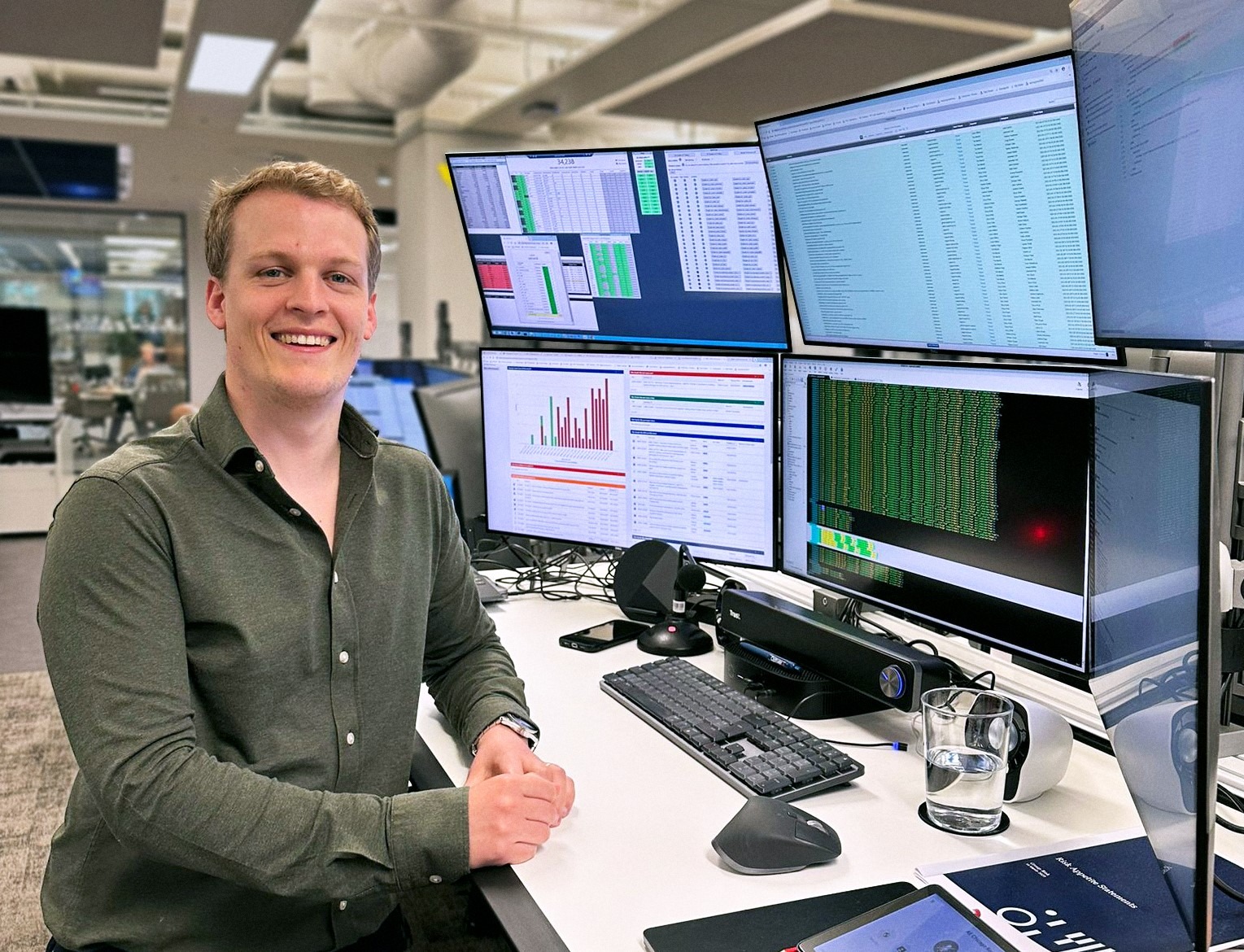
The role of an Application Engineer (AE), also known as Production Engineer, is crucial to Optiver’s trading operations. The team sits directly alongside the traders, working to safeguard our trading systems. Their role is a balancing act – ensuring an orderly production environment while guaranteeing profitability and sustainable growth. They must navigate the complexity of scaling a distributed system handling over half a million financial instruments across numerous data centres and servers, all while striving for simplicity, dependability and operational excellence.
We caught up with William, a member of our London team, to find out what a typical day is like for an Application Engineer on the early morning shift.
Handover from the Asian Hours shift
My day kicks off at 6:30 a.m. as the team makes their way into the office. Since Optiver US (which includes Optiver London) operates 23 hours a day, five days a week, trading is already well underway.
I connect with my US-based colleagues via our Zoom video call to review any urgent issues that need my immediate attention from the Asian Trading Hours shift. After settling down, I perform my routine beginning-of-day checks to ensure a clean production state. Next, we hold a stand-up meeting with the London and Chicago AEs, discussing the previous night’s events and taking over any unresolved issues.
Start of the European Hours shift
By 7 a.m., support is in the London AEs’ hands. I monitor Slack and alerts, tackling any arising issues. This time also allows me to review the list of changes that need to be picked up and choose the ones I’ll handle.
After this, I take a short break to grab some breakfast before diving into a blend of production support and project work. This could involve tasks ranging from Python scripting to large configuration changes or even architectural design. Project work is a highlight for me, as I get a chance to have a real impact on how things are done.
US pre-open
The pace intensifies around 12:30 p.m., when applications for the East Coast exchanges start up. Given the high volume of applications and the limited time frame to resolve issues, it’s important for us to act quickly and decisively during this critical time of the day.
Working together with the London and Chicago developers, we troubleshoot any problems that arise. I enjoy the unpredictable nature of this part of the day, as you need to be ready to jump on any kind of issue and find innovative solutions to mitigate, fix or escalate.
During bigger outages, the trading floor can get pretty lively, and we have to closely collaborate with our local and US-based Network Engineers, Linux Engineers, Developers and Traders to find a solution.
Handoff to Chicago
Around 1:30 p.m., the Chicago AEs come in, and we have another stand-up meeting to go through the day’s events and hand off any outstanding tasks. With the transition complete, we are no longer required to constantly have someone at their desk to monitor the live trading environment, and meetings can now take place.
Meetings I particularly enjoy are the Design Reviews, where someone presents their work and gathers insightful feedback from members of various teams. These sessions are a valuable opportunity to learn and see other ways to approaching a problem.
End of day
Around 4 p.m., the workday is usually over for the London AEs. It’s then time to head home or participate in one of the frequent Optiver social events, which is always a great way to unwind with the rest of the team!
Interested in working at Optiver?
This insight into the life of an Application Engineer during the night shift in London serves as a glimpse into our global operations, including our Amsterdam office. Our Production Engineers in Amsterdam play a similarly critical role, focusing on ensuring the seamless operation and optimization of our trading platforms during market hours.
Get ready to make your impact on Optiver’s industry leading trading systems by applying for one of our open roles today!